Written by Spring Valley Turkey Farm
Ask five people how they cook their Thanksgiving turkey and you’ll get six answers. One swears by a dry brine. Another smokes theirs in the backyard wearing a winter coat. Somebody’s brother-in-law has been lobbying to deep fry since 2019.
If you’ve already read our step-by-step guide to roasting a fresh turkey, this post is for the curious. Here’s what each popular method does, what to know before you try it, and how to keep everyone safe while you do.
First, a Word About That Ice
Your fresh Spring Valley turkey is kept deeply chilled, so you may notice some ice in the cavity or around the joints. That’s normal, and it doesn’t affect quality or taste. For roasting it’s no problem at all. For a few of the methods below, especially frying, you’ll want every bit of ice gone and the bird patted dry, so give it time in the refrigerator first.
Dry Brine: Salt Now, Thank Yourself Later
A dry brine is simply salt (and, if you like, herbs and spices) rubbed all over the turkey one to three days before cooking. The salt seasons the meat deeply while helping it hold on to moisture, and leaving the bird uncovered in the refrigerator dries the skin so it crisps beautifully in the oven. There’s no bucket of salty water to wrestle into your fridge, which is a real selling point.
- How: Pat the turkey dry, rub the salt mixture over and under the skin, and set the bird on a tray in the refrigerator.
- Mind the salt: Different brands of kosher salt measure differently, so follow a trusted recipe’s amount for your turkey’s weight.
- Go easy later: Don’t salt again before roasting, and keep the gravy and stuffing lightly seasoned.
Our turkeys are raised with no additives, so you start with a blank slate and decide how seasoned you want the bird to be.
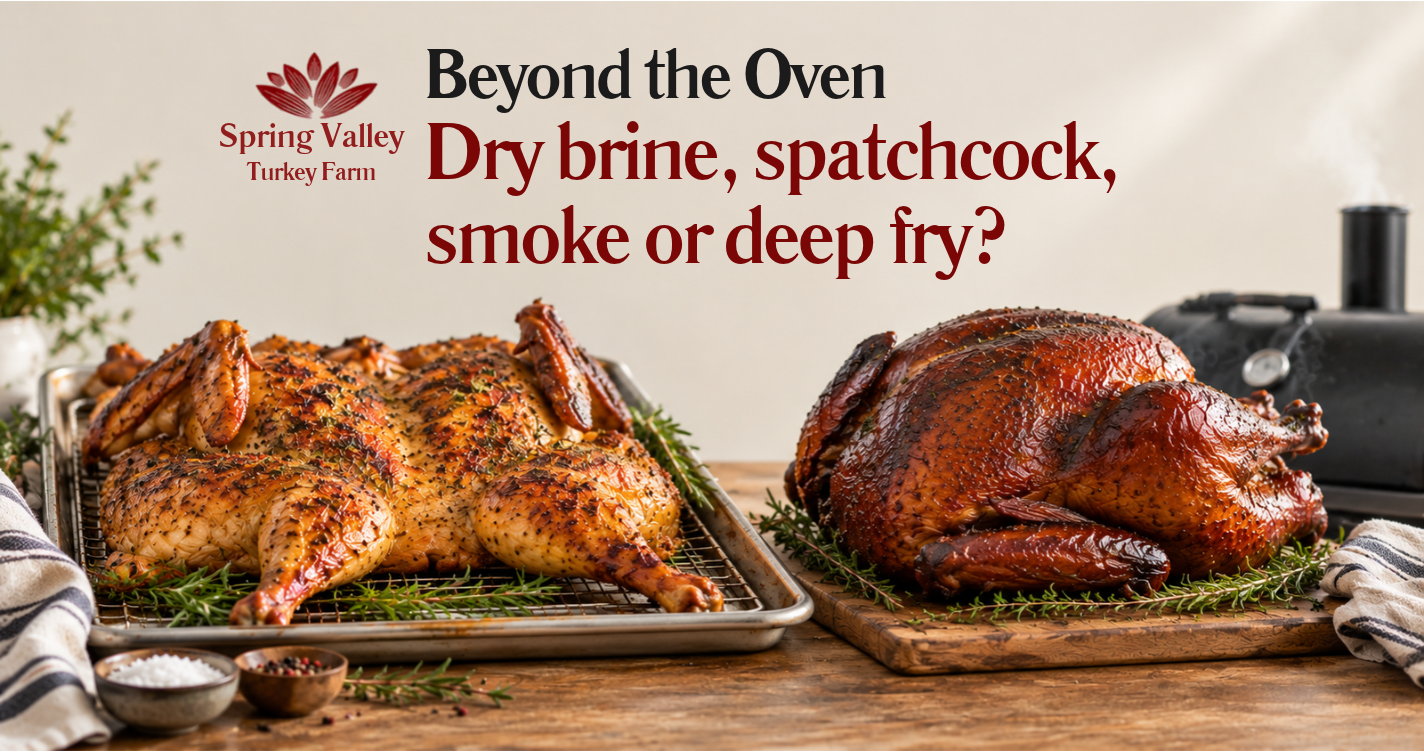
Spatchcock: The Flat-Out Faster Option
Spatchcocking means removing the backbone and pressing the turkey flat. A flat bird cooks faster and more evenly, and nearly all of the skin faces the heat, which means more crispy bites for everyone.
- You’ll need: Sturdy kitchen shears or a sharp knife, and a large rimmed baking sheet with a rack.
- Best for: Mid-size birds. A very large turkey may not fit flat in your pan or oven, so measure first.
- Keep the backbone: It makes outstanding gravy.
- Watch the thermometer, not the clock: A flat turkey can finish much sooner than you expect, so begin checking the temperature early. The USDA classifies spatchcocking as an advanced technique, so give yourself a calm hour for the prep.
Smoked: Outside Is the New Oven
Smoking a turkey frees up the oven for stuffing, rolls and pies, which makes it a favorite for big gatherings. The USDA advises keeping the smoker temperature steady, roughly between 225°F and 300°F, and estimates about 20 to 30 minutes per pound. That means a 14-pound bird could take roughly five to seven hours, so plan an early start and a long rest.
- Do not stuff a smoked turkey. It takes too long for the stuffing to reach a safe temperature.
- Shield the smoker from wind so the temperature stays steady.
- Use a food thermometer. Smoke color and cooking time can’t tell you when it’s done.
Deep Fried: High Reward, High Respect
A fried turkey has devoted fans, and it’s also the method that earns the most warnings from fire safety experts. If you’re going to do it, the USDA’s deep fat frying guidance is worth reading first. The essentials:
- Outdoors only, on flat, level ground well away from your house, garage, deck and trees.
- Completely thawed and dry. Water and hot oil are a dangerous combination, so make sure there’s no ice left in the cavity and pat the bird dry.
- Unstuffed, and on the smaller side. USDA guidance points to birds around 12 pounds or less, and your fryer’s manual may set its own limit. If frying is your plan, choose our smallest size range when you reserve.
- Oil at about 350°F, monitored with a thermometer, with the burner turned off while you lower the turkey in slowly.
- Never walk away, and keep a grease-rated fire extinguisher nearby. Never use water on an oil fire.
If that list makes you nervous, there’s no shame in the smoker or the oven. A perfect turkey doesn’t have to come with a fire drill.
So Which Method Should You Choose?
- Juicy meat and crisp skin with the least fuss: dry brine, then roast.
- Less time and more crispy skin: spatchcock.
- A busy oven: smoke it outside.
- A great story at the table: fry, carefully.
Whatever You Pick, the Safety Rules Stay the Same
Every method ends with the same finish line: 165°F in the thickest part of the breast, the innermost part of the thigh and the innermost part of the wing, checked with a food thermometer. Skip washing the raw turkey, keep it refrigerated until you’re ready, and get leftovers into the refrigerator within two hours. The USDA’s Turkey Basics: Safe Cooking guide covers each of these methods in more detail.
Not sure what size to order for your method and your crowd? Our turkey size guide can help.
Whichever way you cook it, great turkey starts with a fresh one. Reserve your fresh Thanksgiving turkey now and pick it up at Spring Valley Turkey Farm, 402 Spring Valley Road, Old Bridge, NJ 08857.
Questions? Call 732-970-5265 or email Turkeys@SpringValleyNJ.com.
Proudly Veteran Owned & Operated.
Fresh • Locally Raised • USDA Processed • Oven-Ready