
What’s in Season in New Jersey This August?
August 6, 2026
When Should You Order Your Thanksgiving Turkey in New Jersey?
August 17, 2026
Published by Spring Valley Turkey Farm
Hosting Thanksgiving for the first time can feel like a big undertaking. There’s the guest list, the turkey, the side dishes, the timing, the table, the desserts, and the realization that somehow everything needs to be hot and ready at the same time.
The good news? Hosting Thanksgiving dinner doesn’t have to be overwhelming.
With a little planning, a realistic menu, and the right Thanksgiving turkey, you can spend less time stressing in the kitchen and more time enjoying the holiday with the people around your table.
Whether you’re planning an intimate Thanksgiving dinner or hosting a house full of family and friends, this first-time Thanksgiving hosting guide will walk you through where to start.
1. Start With Your Thanksgiving Guest List
Before you plan the menu or order your turkey, figure out approximately how many people you’ll be feeding.
Your guest count affects almost everything else:
-
The size of your Thanksgiving turkey
-
How many side dishes you need
-
How much seating you’ll need
-
The number of appetizers and desserts
-
How much refrigerator and oven space you’ll need
-
Whether you want enough turkey for leftovers
You don’t necessarily need an exact headcount months ahead of time, but having a reasonable estimate will make the rest of your Thanksgiving planning much easier.
And remember: Thanksgiving leftovers are part of the fun.
If your family looks forward to turkey sandwiches, turkey soup, turkey pot pie, or a second plate on Friday, make sure you account for a little extra when choosing your bird.
2. Figure Out What Size Thanksgiving Turkey You Need
One of the most common questions for first-time Thanksgiving hosts is:
“What size turkey should I buy?”
The answer depends on your number of guests, whether you have children attending, how many side dishes you’re serving, and—perhaps most importantly—how much you love leftovers.
We put together a complete Thanksgiving Turkey Size Guide – What Size Turkey Do You Need? to make choosing the right turkey easier.
Planning your turkey size ahead of time is especially important when purchasing a fresh, locally raised Thanksgiving turkey, since local farms have a limited number of birds available each season.
At Spring Valley Turkey Farm in Old Bridge, New Jersey, we raise Broad Breasted White turkeys for the holiday season, with birds generally ranging from approximately 12 to 35 pounds.
If you’re unsure what size to reserve, don’t be afraid to ask. Helping families choose the right turkey for their Thanksgiving table is part of the experience of buying directly from a local farm.
3. Reserve Your Thanksgiving Turkey Early
If you plan on serving a fresh Thanksgiving turkey, ordering early is one of the easiest things you can do to make Thanksgiving week less stressful.
Unlike the frozen turkeys stacked in supermarket freezers, farm-fresh turkeys are seasonal and limited.
That means waiting until Thanksgiving week to start looking for a local turkey may leave you with fewer options.
At Spring Valley Turkey Farm in Old Bridge, NJ, Thanksgiving turkey reservations traditionally open around Labor Day.
Planning ahead gives you one very important item to cross off your Thanksgiving checklist early:
The turkey is handled.
Then you can move on to the mashed potatoes.
4. Keep Your Thanksgiving Menu Manageable
Your first Thanksgiving dinner does not need 14 side dishes.
One of the biggest mistakes first-time Thanksgiving hosts make is creating a menu that is simply too ambitious.
Instead, build your meal around the essentials.
A classic Thanksgiving menu might include:
-
Fresh roasted turkey
-
Stuffing or dressing
-
Mashed potatoes
-
Gravy
-
Cranberry sauce
-
One or two vegetables
-
Dinner rolls
-
One or two desserts
Once those are covered, add family favorites if you have the time and kitchen space.
If Aunt Mary absolutely needs her sweet potato casserole to consider it Thanksgiving, add it.
If nobody actually eats the elaborate vegetable dish you make every year because tradition says you’re supposed to, this may be the year to skip it.
A smaller menu prepared well is almost always better than an enormous menu that leaves the host exhausted.
5. Add Some Jersey Fresh Flavor to Your Thanksgiving Table
Hosting Thanksgiving in New Jersey gives you a great opportunity to incorporate local ingredients into your holiday meal.
The New Jersey Department of Agriculture promotes locally grown products through the Jersey Fresh program, and seasonal New Jersey ingredients can make great additions to a Thanksgiving menu.
Depending on availability, think about incorporating ingredients such as:
-
Apples
-
Cranberries
-
Sweet potatoes
-
Squash
-
Cabbage
-
Kale
-
Local honey
The New Jersey Department of Agriculture also offers Jersey Tastes recipes featuring locally grown ingredients and seasonal inspiration.
Pairing seasonal New Jersey ingredients with a locally raised turkey is a great way to create a Thanksgiving dinner that truly celebrates the Garden State.
6. Make a Thanksgiving Cooking Timeline
The secret to a calmer Thanksgiving Day is deciding when everything needs to happen before Thanksgiving morning arrives.
Work backward from the time you want to serve dinner.
For example, if dinner is at 4:00 p.m., determine:
-
When the turkey needs to go into the oven
-
When appetizers should be set out
-
Which side dishes can be prepared ahead
-
When casseroles need to be reheated
-
When potatoes should be cooked
-
When the turkey should come out and rest
-
When gravy should be made
-
When everything needs to move into serving dishes
Your turkey will generally dictate much of your Thanksgiving Day schedule, so determine its approximate cooking time first.
The USDA provides an official turkey roasting guide with estimated cooking times for different turkey weights.
Remember that cooking times are estimates. A food thermometer—not the clock—is ultimately what tells you when your turkey is safely cooked.
7. Don’t Forget the Meat Thermometer
If there is one inexpensive kitchen tool every Thanksgiving host should have, it’s a reliable food thermometer.
According to the USDA Food Safety and Inspection Service, turkey should reach a safe minimum internal temperature of 165°F.
Temperature should be checked in multiple locations, including the thickest part of the breast and the innermost portions of the thigh and wing.
Don’t rely solely on the color of the meat, the juices, or a pop-up timer.
Using a thermometer removes much of the guesswork from cooking Thanksgiving turkey—and can help you avoid both undercooking and unnecessarily overcooking your bird.
8. Understand the Difference Between Fresh and Frozen Turkey
If you’ve always purchased a supermarket turkey, you may be accustomed to bringing home a frozen bird days—or even weeks—before Thanksgiving.
Frozen turkeys require advance thawing.
According to FoodSafety.gov’s turkey guidance, refrigerator thawing generally requires about 24 hours for every 4 to 5 pounds of turkey.
That means a large frozen Thanksgiving turkey can take several days to thaw completely.
A fresh turkey eliminates that multi-day thawing process.
For first-time hosts already juggling refrigerator space, desserts, side dishes, and holiday preparations, that can be one less major step to plan around.
9. If You Do Buy Frozen, Thaw Your Turkey Safely
If you’re cooking a frozen turkey rather than a fresh one, don’t leave it sitting on the kitchen counter to thaw.
The USDA identifies three safe methods for thawing turkey:
-
In the refrigerator
-
In cold water
-
In the microwave
You can read the USDA’s complete Turkey Basics: Safe Thawing guide before Thanksgiving.
This is another reason your turkey choice should be made well before Thanksgiving morning. A large frozen bird may require several days in the refrigerator before it is ready to cook.
10. Prepare as Much as Possible Before Thanksgiving Day
Thanksgiving morning should not be the first time you touch every ingredient.
A number of Thanksgiving tasks can be completed ahead of time.
Depending on your recipes, you may be able to:
-
Chop vegetables
-
Prepare cranberry sauce
-
Bake pies
-
Assemble casseroles
-
Set the Thanksgiving table
-
Organize serving dishes
-
Label serving utensils
-
Prepare appetizers
-
Make certain sauces
-
Measure ingredients
-
Chill drinks
One simple trick is to pull out every platter, bowl, and serving utensil you plan to use the night before.
You can even place a small note inside each dish indicating what will go in it.
When the kitchen gets busy on Thanksgiving afternoon, you won’t be searching through cabinets for Grandma’s gravy boat.
11. Think About Oven Space Before Thanksgiving
There is one appliance every Thanksgiving dish seems to want at exactly the same time:
The oven.
Unfortunately, your turkey has already claimed it.
Before finalizing your Thanksgiving menu, look at the cooking temperature and cooking time for every dish.
If your turkey is roasting at one temperature while three casseroles require another, you’ll need a plan.
Consider:
-
Making certain dishes ahead and reheating them
-
Using your stovetop
-
Using a slow cooker for appropriate dishes
-
Serving one or two sides at room temperature
-
Preparing desserts the day before
-
Asking guests to bring dishes that arrive ready to serve
This is one of those small Thanksgiving planning details that can make an enormous difference on the actual holiday.
12. Cook Stuffing Safely
Families have strong opinions about stuffing.
Inside the turkey?
Outside the turkey?
Technically dressing?
We’re staying out of that argument.
From a food-safety standpoint, however, the USDA recommends cooking stuffing separately for more even cooking and optimal safety.
If you do cook stuffing inside your turkey, the center of the stuffing must also reach 165°F.
You can find additional guidance in the USDA’s Turkey Basics: Stuffing resource.
Whatever your family tradition happens to be, food safety should always come first.
13. Give Yourself More Time Than You Think You Need
Very few Thanksgiving guests complain because dinner is 20 minutes early.
A kitchen full of hungry relatives waiting two hours for a turkey, however, is another story.
Build extra time into your Thanksgiving schedule.
Turkey cooking times vary based on weight, your oven, and other factors. Side dishes take longer to reheat than expected. Gravy happens. Someone inevitably needs the oven at the exact wrong moment.
And sometimes the host simply deserves five minutes to sit down.
Planning a buffer into your schedule makes all of those little Thanksgiving surprises much easier to handle.
14. Have an Appetizer Strategy
You don’t need to serve an elaborate cocktail-hour spread before a giant Thanksgiving dinner.
A few simple appetizers can keep guests happy without filling everyone up before the turkey hits the table.
Think:
-
Cheese and crackers
-
A simple charcuterie board
-
Vegetables and dip
-
Nuts
-
Olives
-
A seasonal spread
-
One warm appetizer
The goal is to give your guests something to snack on—not accidentally serve Thanksgiving dinner before Thanksgiving dinner.
15. Don’t Forget About Thanksgiving Leftovers
Before Thanksgiving Day, make sure you have containers or storage bags available for leftovers.
FoodSafety.gov recommends refrigerating Thanksgiving leftovers promptly rather than allowing them to sit out for hours. Their Thanksgiving leftover safety guidance recommends storing leftovers within two hours and dividing large quantities into smaller portions so they cool more quickly.
Extra turkey can become some of the best meals of Thanksgiving weekend:
-
Turkey sandwiches
-
Turkey soup
-
Turkey pot pie
-
Turkey salad
-
Turkey quesadillas
-
Turkey and stuffing bowls
-
Turkey breakfast hash
So when you’re deciding what size Thanksgiving turkey to order, consider whether your household is firmly on Team Leftovers.
16. Remember Why You’re Hosting Thanksgiving in the First Place
Your turkey doesn’t have to look like a magazine cover.
Your napkins don’t all need to match.
And nobody will remember if one casserole reaches the table five minutes after everything else.
They’ll remember gathering together.
Thanksgiving has always centered around food, family, gratitude, and tradition. Choosing ingredients thoughtfully, preparing what you can ahead of time, and creating a realistic plan allows you to actually participate in the holiday instead of spending the entire day stressed in the kitchen.
Make a Farm-Fresh Turkey the Centerpiece of Your New Thanksgiving Tradition
If you’re hosting Thanksgiving for the first time this year, we’d love to be a small part of your family’s new tradition.
Spring Valley Turkey Farm is a local, veteran-owned farm in Old Bridge, New Jersey, offering fresh Thanksgiving and Christmas turkeys to families throughout Central New Jersey and beyond.
Our Broad Breasted White turkeys are raised for the holiday season and processed fresh shortly before pickup, so your Thanksgiving centerpiece doesn’t have to spend weeks sitting in a freezer.
Thanksgiving turkey reservations typically open around Labor Day, with turkey sizes generally ranging from approximately 12 to 35 pounds.
Whether this is your first Thanksgiving as the host or your twentieth, there’s something special about picking up your turkey directly from a local farm and bringing it home for the holiday table.
Planning Thanksgiving now?
Start by reading our What Size Thanksgiving Turkey Do You Need? guide, and keep an eye on Spring Valley Turkey Farm for updates when 2026 Thanksgiving turkey reservations open.
Spring Valley Turkey Farm
Old Bridge, New Jersey
Fresh, locally raised Thanksgiving & Christmas turkeys.
Follow Spring Valley Turkey Farm for turkey reservation announcements, farm updates, Thanksgiving planning tips, recipes, and more.
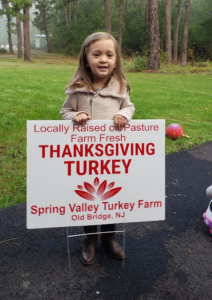
A future generation of farm supporters! Spring Valley Turkey Farm is proud to provide locally raised, pasture-raised Thanksgiving turkeys for families throughout New Jersey.